

As a supplier of Hydraulic Disc Brakes for e-bikes, I've witnessed firsthand the critical role that braking performance plays in ensuring rider safety. One of the most challenging scenarios for any braking system is wet conditions. In this blog, we'll delve into the braking performance of hydraulic disc brakes on e-bikes when the roads are wet.
Understanding Hydraulic Disc Brakes
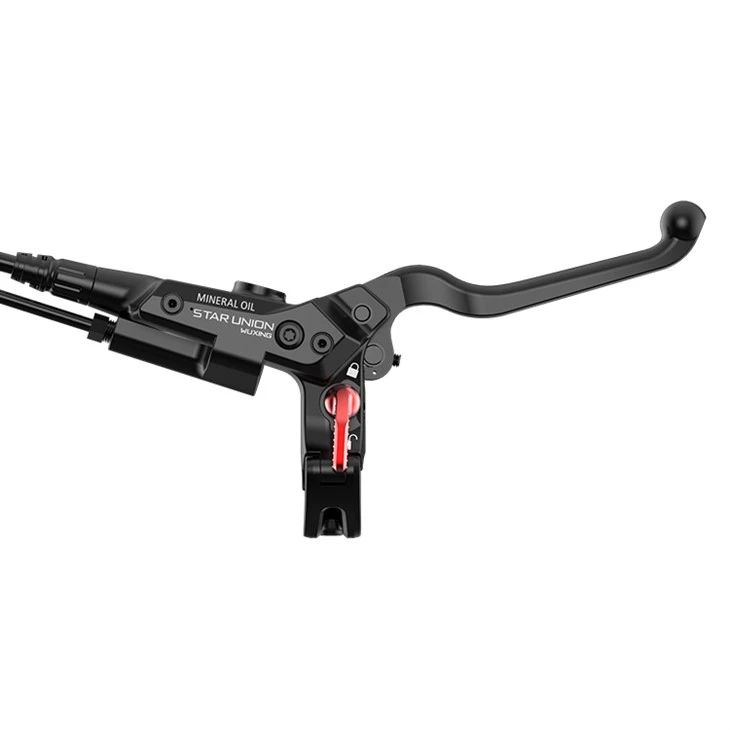
Before we discuss their performance in wet conditions, let's briefly understand how hydraulic disc brakes work. Hydraulic disc brakes use a fluid - typically brake fluid - to transfer force from the brake lever to the brake caliper. When the rider squeezes the brake lever, it pushes a piston in the master cylinder, which in turn forces the brake fluid through a series of hoses to the caliper. The caliper then clamps down on the brake disc, creating friction and slowing down the wheel.
This system offers several advantages over traditional rim brakes. It provides more consistent and powerful braking, better modulation, and is less affected by external factors such as dirt and debris. However, wet conditions pose a unique set of challenges.
Challenges in Wet Conditions
Wet conditions can significantly impact the braking performance of any e - bike. Water on the brake disc and pads can act as a lubricant, reducing the friction between them. This means that the brakes need to work harder to achieve the same level of stopping power as in dry conditions.

The temperature of the brake components also plays a role. When it's wet, the brake discs and pads cool down more quickly due to the water. This can lead to a decrease in the coefficient of friction, as the optimal operating temperature for brake materials is usually higher. Additionally, water can cause corrosion on the brake components over time, which may further degrade performance.
How Hydraulic Disc Brakes Fare in the Wet
Despite the challenges, hydraulic disc brakes generally perform better than rim brakes in wet conditions. The design of hydraulic disc brakes keeps the braking components (disc and caliper) relatively protected from direct water spray. The brake discs are located close to the hub of the wheel, and the calipers are often shielded by the bike frame or fork.
Moreover, hydraulic disc brakes can generate higher clamping forces compared to rim brakes. This means that even with the reduced friction caused by water, they can still provide a significant amount of stopping power. The fluid - based system also allows for a more precise application of force, enabling riders to modulate the brakes more effectively in wet conditions.
Our Product Line and Performance
At our company, we offer a range of hydraulic disc brakes for e - bikes, including the 221PYDZJS, 221PYDZJ, and 221PYDZJ Pro. These brakes are designed with high - quality materials and advanced engineering to ensure optimal performance in all conditions, including wet weather.
The 221PYDZJS features a lightweight yet durable design. It uses high - friction brake pads that are formulated to maintain good performance even when wet. The caliper is designed to quickly shed water, reducing the amount of time the brake components are in contact with the water.
The 221PYDZJ takes things a step further. It has an improved hydraulic system that provides even more consistent braking performance. The brake discs are made of a special alloy that resists corrosion, ensuring long - term reliability in wet conditions.
Our top - of - the - line model, the 221PYDZJ Pro, is the ultimate choice for riders who demand the best. It features advanced pad materials that are optimized for wet - weather performance. The hydraulic system is finely tuned to provide maximum stopping power with minimal effort from the rider.
Testing and Validation
To ensure the performance of our hydraulic disc brakes in wet conditions, we conduct extensive testing. We simulate wet conditions in our laboratory, using specialized equipment to spray water on the brake components while measuring the braking force and stopping distance.
We also test our brakes on real - world roads during rainy weather. Our team of engineers rides e - bikes equipped with our brakes to gather data on how they perform in actual riding situations. This real - world testing allows us to fine - tune our products and make any necessary improvements.
Tips for Riders in Wet Conditions
Even with high - performing hydraulic disc brakes, riders need to take extra precautions in wet conditions. Here are some tips:
- Increase your following distance: Since the stopping distance is longer in wet conditions, give yourself more space between you and the vehicle or rider in front of you.
- Brake earlier and more gently: Avoid sudden, hard braking, as this can cause the wheels to lock up. Instead, apply the brakes gradually to maintain control.
- Keep your brakes clean: Regularly clean your brake discs and pads to remove any dirt, debris, or corrosion that may affect performance.
Conclusion
The braking performance of hydraulic disc brakes on e - bikes in wet conditions is a complex but crucial topic. While wet conditions present challenges, hydraulic disc brakes offer significant advantages over other braking systems. At our company, we are committed to providing high - quality hydraulic disc brakes that perform well in all conditions, including the wet.
If you're in the market for reliable hydraulic disc brakes for your e - bike, we invite you to explore our product line. Our 221PYDZJS, 221PYDZJ, and 221PYDZJ Pro models are designed to meet the needs of different riders and budgets. Contact us to discuss your requirements and start a procurement negotiation. We look forward to working with you to ensure the safety and performance of your e - bikes.
References
- "The Physics of Braking Systems" - Journal of Automotive Engineering
- "Performance of Bicycle Brakes in Wet Conditions" - International Cycling Research Journal
- "Hydraulic Disc Brake Technology" - Technical Papers in Mechanical Engineering