


Hydraulic Disc Brake
Your Professional Hydraulic Disc Brake Supplier
Founded in 1985, our company has grown into a reliable manufacturer of e-bike components with long experience in design, R&D, and production. We operate two manufacturing bases built to national and European standards and run stable production lines for key systems used in electric bicycles, mini e-scooters, GB e-bikes, and electric motorcycles. Our team includes over 1,100 employees, among them 130 R&D engineers and 64 QC specialists who ensure consistent quality. With advanced testing and inspection equipment, we provide controlled and dependable manufacturing for global customers who require steady supply and strong technical support.
-
![222PYDJ/2 Max]() 222PYDJ/2 Max● Caliper Model:KQ600 ● Sight Glass ● Six piston forged caliper ● Caliper Mounting Hole Spacing 112mm ● Increased Brake Fluid Reservoir Capacity ● Ø 7mm Hose Mineral oil /...read more
222PYDJ/2 Max● Caliper Model:KQ600 ● Sight Glass ● Six piston forged caliper ● Caliper Mounting Hole Spacing 112mm ● Increased Brake Fluid Reservoir Capacity ● Ø 7mm Hose Mineral oil /...read more -
![222PYDJ/2 Pro]() 222PYDJ/2 Pro● Caliper Model:KQ5402 ● Sight Glass ● Mirror caliper ● 5mm Thickness pad ● Stronger braking force ● Electric cutoff switch option ● Ø 5mm Hose Mineral oil / Ø 7mm...read more
222PYDJ/2 Pro● Caliper Model:KQ5402 ● Sight Glass ● Mirror caliper ● 5mm Thickness pad ● Stronger braking force ● Electric cutoff switch option ● Ø 5mm Hose Mineral oil / Ø 7mm...read more -
![3201PYD]()
-
![LP-61]()
-
![221PYDZJS Pro]() 221PYDZJS Pro● Better parking structureread more
221PYDZJS Pro● Better parking structureread more
● Increased Brake Fluid Reservoir Capacity
● Sight Glass
● Four piston forged caliper -
![221PYDZJS]()
-
![240PYD]()
-
![221PYDZJ Pro]() 221PYDZJ Pro● Caliper model:KQ223 ● Sight glass ● Better parking structure ● Four piston forged caliper ● Mirrored caliper ● Increased brake fluid reservoir capacityread more
221PYDZJ Pro● Caliper model:KQ223 ● Sight glass ● Better parking structure ● Four piston forged caliper ● Mirrored caliper ● Increased brake fluid reservoir capacityread more -
![222PYDJ Max]() 222PYDJ Max● Caliper Mounting Hole Spacing 112mmread more
222PYDJ Max● Caliper Mounting Hole Spacing 112mmread more
● Increased Brake Fluid Reservoir Capacity
● Sight Glass
● Six piston forged caliper
● Ø 7mm Hose -
![221PYDZJ]()
-
![220PYD Pro]() 220PYD Pro● Four piston forged caliperread more
220PYD Pro● Four piston forged caliperread more
● 2.3mm Thickness disc design
● 2/3/4 Finger lever blade option
● Top loading pad design -
![220PYD]()


Why choose us
Advanced R&D Capability
Our R&D team holds over 300 patents and covers industrial design, electronics, software, structure, optics, and production engineering.
Certified Quality System
We operate a professional QC team with 64 engineers and the only CNAS-certified lab among Chinese component manufacturers.
OEM/ODM Service
The company provides OEM and ODM services provide tailored engineering and product solutions based on customer requirements, supported by efficient project management.
After-Sale Service
Our team responds within 24 hours and offers reliable technical assistance to secure smooth operation for all partners.
Hydraulic Disc Brake
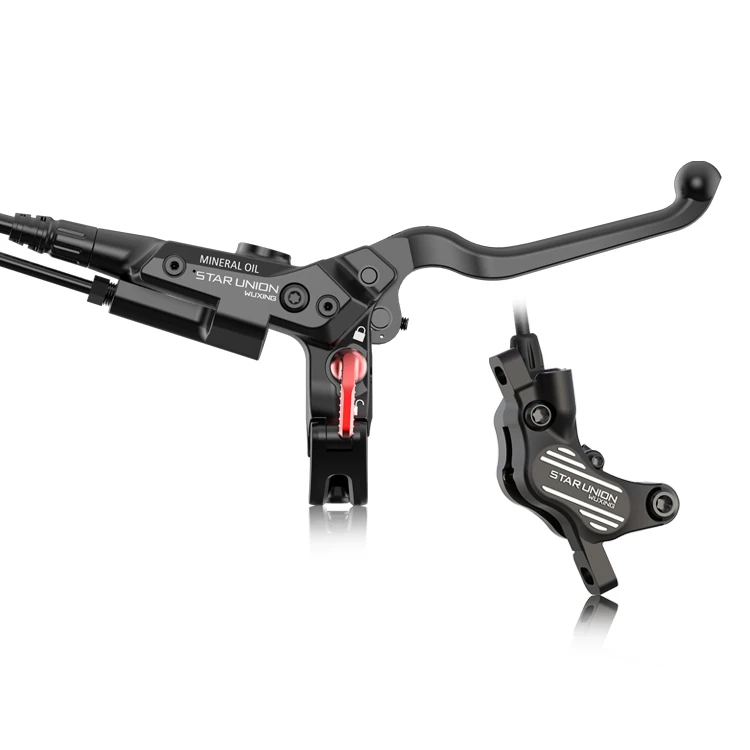
Hydraulic disc brakes are a type of brake system used on most modern bicycles. They use hydraulic fluid to transfer force from the brake lever to the caliper, which then clamps down on the brake rotor to slow the bike down. This type of braking system is much more efficient and powerful than traditional cable-actuated brakes, and is now the most common type of bicycle brake.
Maintenance and Elite Feeling
The main benefit of a hydraulic system is its incredible stopping and stooping power on off-road trails. The hydraulic disc brake is superior to everyone else in this industry in terms of sensitivity, efficiency, and dependability.
Applying Force
A hydraulic brake is only a push to stop your sweetheart, whereas a mechanical brake requires more pressure to achieve the same force. However, compared to other systems, the suffering proportion in a hydraulic system is almost 10%.
Price
Many mechanics believe that hydraulic brakes are expensive. But that is not accurate in all circumstances. Additionally, the cost of hydraulic maintenance is nearly free. Change the fluid after a given amount of time.
Weight
Hydraulic braking systems are much lighter than other brakes.
Efficiency and Compatibility
One of the primary advantages of choosing hydraulics is that it is dependable in every weather condition. Fully hydraulic disc brakes are by far the definitive performance champion. They have greater power, better control, and are typically lighter. They transfer force from the lever to the caliper more effectively than other systems, which accounts for a large portion of their performance advantage.
Applications of Hydraulic Disc Brake
In the mountain bike sector
Its excellent heat dissipation performance maintains stable braking performance even under prolonged high-intensity braking, reducing brake fade and making it suitable for the continuous braking demands of off-road riding.
In the road bike sector
Its good braking stability maintains stable braking performance even at high speeds, reducing the danger caused by brake failure.
In the urban commuting and leisure riding sector
Its relatively good dirt resistance allows it to withstand pollution such as mud and oil in urban environments, maintaining stable braking performance.
Components of Hydraulic Disc Brake
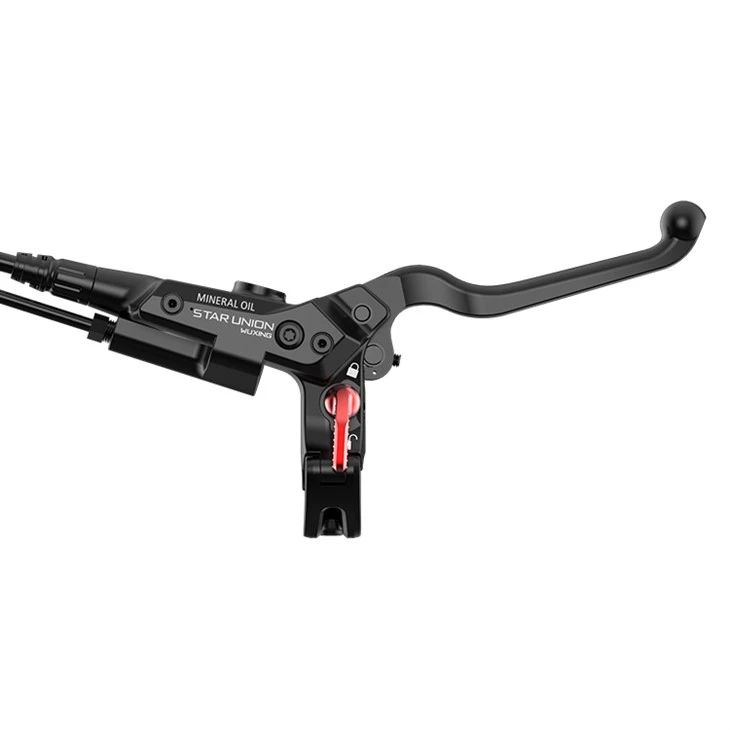
Lever + master cylinder
Pulling the lever pushes a piston inside the master cylinder, pressurizing the brake fluid.
Hydraulic fluid
An incompressible medium (mineral oil or DOT brake fluid) transmits pressure from the master cylinder to the caliper with minimal loss.
Hose or sealed line
Conveys pressure while remaining flexible and resistant to heat and compression.
Caliper and pistons
Pressurized fluid moves caliper pistons outward, forcing brake pads against the rotating rotor.
Rotor + pads
Friction between pads and rotor converts kinetic energy into heat, slowing the wheel.
Reservoir and seals
Compensate for pad wear and temperature expansion, keep air out of the system.
Step-by-step operating sequence of Hydraulic Disc Brake
Lever movement
Rider squeezes the lever; master-cylinder piston displaces fluid volume.
01
Pressure generation
Fluid pressure rises uniformly throughout the closed hydraulic circuit (Pascal’s principle).
02
Piston extension
Caliper pistons respond by extending; both sides of a two-sided caliper push pads inward, squeezing the rotor.
03
Frictional braking
Pads clamp the rotor; the friction torque reduces wheel speed.
04
Release and return
Releasing the lever allows return springs and fluid flow back to retract pistons slightly; reservoir equalizes fluid and prevents vacuum.
05
Mechanical advantage: Master piston diameter vs. caliper piston area determines force multiplication and required lever travel. Smaller master bore = higher pressure for same lever force (but more lever travel).
Pascal’s law: Pressure applied anywhere in the enclosed fluid is transmitted equally in all directions; pressure = force / master piston area.
Heat management: Friction generates heat in the rotor; rotors, pad materials, and caliper design manage thermal buildup. Excess heat changes fluid viscosity and can cause fade if extreme.
Seal behavior: Flexible seals keep fluid contained and allow controlled piston retraction for pad clearance. Proper seal design prevents leaks and minimizes sponginess.
Air is detrimental: Air compresses, reducing firmness and travel. Bleeding removes air and restores direct hydraulic response.
How to Adjust Hydraulic Disc Brake
Make sure your bike is well-lit and in a straight position.
Your work will be easy if you place the bikes properly. It makes it simple to service your bike's brakes by allowing you to spin the wheels. By placing your bike on the stand, you can look into the caliper you need to align your disc brake. However, a more laborious method of turning your bike upside down also works if you do not have a stand. The second thing is your bike receives adequate lighting. It will enable you to see clearly and precisely set your disc brake.
Turn the brake caliper bolts loose completely.
It is about time to mount and line your brake calipers. The caliper must first be turned to the bottom and then fully turned back up. Once the caliper is in the appropriate location, you can quickly tighten the caliper nuts by doing this. Also, use caliper bolts with washers on the heads since calipers without washers tend to move in the direction of the tightening bolt.
To align the caliper, tighten the brake lever.
The brake caliper bolts have now been slightly loosened. It enables you to manually regulate the caliper to prevent it from being trapped or hung up on something. Clasp firmly the brake lever to center the caliper. You should slightly tighten the caliper bolts, though. There will be no need for excessive caliper bolt compression.
Center the caliper.
The next step is to spin the wheel of your bike to see if the brake pads and rotor are coming into contact. If you need to realign calipers, you must carefully examine how each piston travels. After this stage, calipers typically demand a little more mastery. But this method of centering the caliper is an excellent beginning.
Use a tool for caliper placement.
The next step is optional and only beneficial for people who find working with their hands uncomfortable.
Use your hand to align the caliper.
Many riders typically favor this approach when it comes to correct adjustment. Using your hand to align the caliper on your bike is more practical.
Straighten the Rotor's bend.
When the rotor is slightly curved, it can sometimes be difficult to center the calipers. In this circumstance, you must first straighten the rotor.
Maintenance checklist
Check pads and rotor wear; replace pads before backing out pistons excessively.
Inspect hoses and fittings for leaks or damage.
Bleed system periodically or if lever feels spongy; use correct fluid type (DOT or mineral oil per manufacturer).
Keep rotors and pads free of oil/grease; decontaminate or replace contaminated pads.
Check caliper alignment and rotor trueness to avoid uneven wear and noise.
FAQ
As one of the leading hydraulic disc brake manufacturers and suppliers in China, we warmly welcome you to wholesale cheap hydraulic disc brake from our factory. All custom made products are with high quality and competitive price.