

Hey there! As a supplier of Star Union hydraulic disc brakes, I'm super excited to chat with you about how these amazing brakes work. So, let's dive right in!
The Basics of Hydraulic Disc Brakes
First off, let's understand what a hydraulic disc brake is. It's a crucial part in many machines and vehicles, used to slow down or stop movement. Star Union hydraulic disc brakes are top - notch in the market, known for their reliability and high performance.
The main components of a Star Union hydraulic disc brake include a brake disc, caliper, hydraulic lines, and a master cylinder. The brake disc is attached to the rotating part of the machine or vehicle, like a wheel. The caliper is positioned around the brake disc, and it's where the magic happens. The hydraulic lines are like the veins, carrying hydraulic fluid, and the master cylinder is the heart that pumps this fluid.
How the Magic Happens: The Working Principle
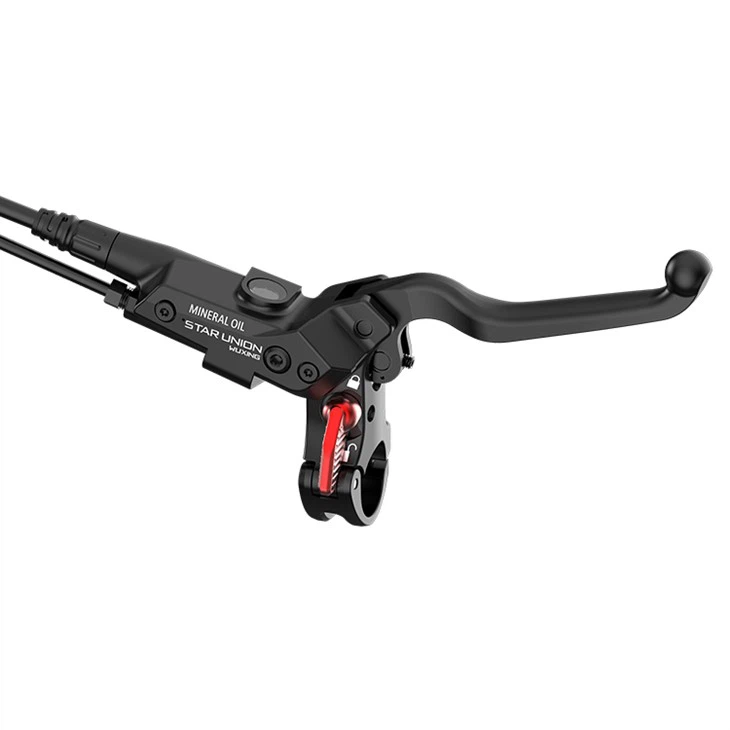
When you want to stop or slow down, you apply pressure to the brake lever or pedal. In a vehicle, it's the brake pedal; in some industrial machines, it could be a lever. This action is the starting point of the whole braking process.
The pressure you apply on the lever or pedal is transferred to the master cylinder. Inside the master cylinder, there's a piston. When you press the lever or pedal, this piston is pushed forward. As the piston moves, it compresses the hydraulic fluid that's inside the master cylinder.
Now, here's where things get interesting. Hydraulic fluid is incompressible. That means when the piston in the master cylinder compresses the fluid, the pressure is transmitted equally throughout the hydraulic lines. This is based on Pascal's principle, which states that a change in pressure applied to an enclosed fluid is transmitted undiminished to all portions of the fluid and to the walls of its container.
The pressurized hydraulic fluid then travels through the hydraulic lines and reaches the caliper. Inside the caliper, there are also pistons. The pressure from the hydraulic fluid forces these pistons to move outward.
As the pistons in the caliper move outward, they push the brake pads against the brake disc. The brake pads are made of a special friction material. When they come into contact with the rotating brake disc, friction is generated. This friction is what slows down or stops the rotation of the brake disc, and in turn, slows down or stops the machine or vehicle.
Star Union's Edge in Hydraulic Disc Brakes
Star Union has some unique features that make their hydraulic disc brakes stand out. For starters, they use high - quality materials for all their components. The brake discs are made of strong and heat - resistant metals, which can withstand the high temperatures generated during braking. The brake pads are designed to have excellent friction characteristics, providing reliable stopping power.
The calipers are precision - engineered. They are designed to ensure that the pressure from the hydraulic fluid is evenly distributed across the brake pads. This means that both sides of the brake disc are squeezed with the same force, resulting in smooth and efficient braking.
Different Models and Their Applications
We have a few popular models in our Star Union hydraulic disc brake range. One of them is the 150PYDZ/2. This model is great for light - duty applications, like small electric vehicles or some light industrial machinery. It offers a good balance between performance and cost - effectiveness.
Then there's the 221PYDZJ Pro. This is a more heavy - duty model. It's designed for larger vehicles and industrial equipment that require a higher level of braking force. It has a more robust caliper design and larger brake pads, which can handle more heat and friction.
And the 221PYDZJS Pro takes things even further. It's our top - of - the - line model, with advanced features for the most demanding applications. It's often used in heavy - duty construction machinery and large commercial vehicles.
Maintenance and Longevity
To keep your Star Union hydraulic disc brakes working at their best, regular maintenance is key. You should check the hydraulic fluid level regularly. If it's low, you need to add more. But make sure to use the recommended type of hydraulic fluid.
Also, inspect the brake pads for wear. Over time, the brake pads will wear down due to friction. When they reach a certain level of wear, they need to be replaced. If you don't replace them, it can affect the braking performance and even damage the brake disc.

The brake discs should also be checked for any signs of damage, like cracks or excessive wear. If there are any issues, it's best to replace the brake disc to ensure safe and efficient braking.
Why Choose Us as Your Supplier
As a supplier of Star Union hydraulic disc brakes, we offer more than just the products. We have a team of experts who can provide you with technical support. Whether you have questions about installation, maintenance, or just want to know more about the working principle, we're here to help.
We also offer competitive pricing. We understand that cost is an important factor for our customers, so we strive to provide high - quality products at a reasonable price.
And our delivery is fast. We know that in many industries, time is of the essence. So, we make sure that your orders are processed and delivered as quickly as possible.
Let's Do Business!
If you're in the market for high - quality hydraulic disc brakes, we'd love to talk to you. Whether you need a single brake for a small project or a large order for an industrial application, we can meet your needs. Don't hesitate to reach out to us for a quote or to discuss your specific requirements. We're looking forward to working with you and helping you find the perfect Star Union hydraulic disc brake solution.
References
- "Hydraulics and Pneumatics: A Technician's and Engineer's Guide" by Andrew Parr
- "Automotive Brakes Manual" by Haynes Publishing Group